Pests We Treat Before & After Photos
Click on a photo to enlarge.
Mud Wasp Infestation in Cliffwood, NJ


I was sent to a home in Cliffwood, NJ when the homeowner contacted Cowleys after finding a wasp nest above a window in a seldom used room.
Upon arrival, I went to the room where there was a wasp nest. Based on the shape and construction of the nest, i immediately recognized it as a mud dauber nest. Mud daubers are solitary wasps that, unlike social wasps like yellow jackets and baldfaced hornets, do not live in colonies with a queen and hundreds of specialized workers. Instead, each female breeds and tends to her own. For the most part, solitary wasps like mud daubers are not territorial with regard to their nests. They are not aggressive, and they seldom sting people.
These wasps also known as dirt daubers or mud wasps, and for good reason. The female constructs small nests by carrying little mud balls to the nest site. She uses the nests to keep her eggs warm. The nests are built as cylindrical tubes that look like a pipe organ (the most common species in New Jersey is known as the organ pipe mud dauber).
I removed the active nest that already had several eggs and wasps in various stages in their life cycle. Homeowners can control mud dauber populations in their home by controlling spider populations since they live, for the most part, on a steady diet of spiders. By sealing cracks where spiders can live and regularly removing spider webs, you should not have a problem with mud daubers. However, if you do start seeing these strange little mud nests around your home, call a pest control technician to remove them. While these guys are not actively looking to sting, if you start trying to scrape away their nests as a weekend DIY project without the right equipment and products, you’re asking for trouble.
Removal of Hornets Nest in Millstone Township, NJ


Recently, I was sent to a home in Millstone Township, NJ for a periodic inspection and service visit that’s included in our residential home protection plans. These plans are valuable to homeowners because we often uncover pest problems that are overlooked by homeowners, especially outdoor infestations and infestations in their early stages.
During my inspection, I observed a hornet just starting to make a nest on an overhang of the front door. Hornets are highly territorial insects and a nest in any high pedestrian traffic area is a problem. If this nest was not removed, residents and guests of this home could easily be perceived as a threat to the nest and suffer the consequences. Hornets are a formidable threat since they often attack as a swarm. Their venom is especially painful because it contains high levels of acetylcholine, a chemical that stimulates our pain receptors. Also, a single hornet is able to sting multiple times because, unlike bees, its stinger remains intact and does not become lodged in the victim. Since hornets are large insects, they carry a good supply of venom, and release more venom per sting than any other stinging insect. Suffice it to say, I was glad that I was able to locate and treat this nest while it was still in its beginning stages of being formed. By removing this nest now, this household avoided a serious stinging insect threat.
Fortunately, since the nest was just starting to be formed it did not pose much of a threat to remove it. And that was just fine with me! First, I sprayed the nest with an aerosol foam to knock down any hornets in the nest. Once I saw that there was no more live activity, I safely removed the nest, bagged it, and carried it with me off the property. The homeowner was quite appreciative that I caught this problem early on before the hornets had a chance to form a mature nest.
Small Opening in Keyport, NJ Not a Problem for Mice


As I was performing a routine service for a Home Protection Plan customer in Keyport, NJ I noticed a viable entry point in the foundation of a house. Believe it or not, this opening is the perfect size for not just pests, but mice to enter the home. In fact mice can squeeze through an opening the size of a dime!
First, I stuff the opening with copper mesh. Copper mesh is an excellent way to exclude rodents from crawling into tights spaces because they are unable to chew through it. Next, I used black caulk to seal the opening. Afterwards I finished treating the home for their regular service.
Bald-Faced Hornets Attack Teen in Manahawkin, NJ

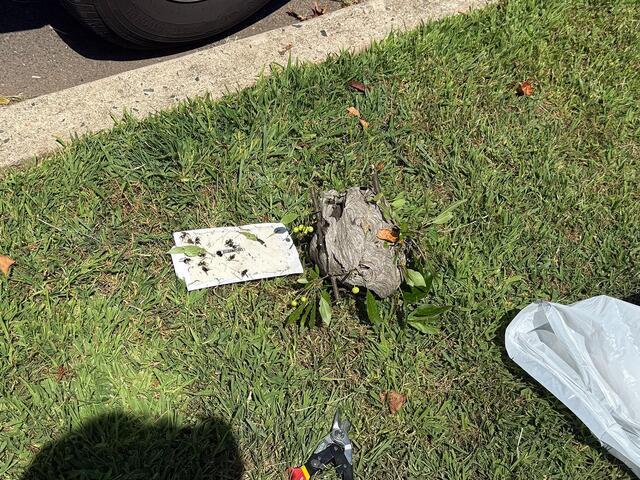
One warm afternoon in Manahawkin, NJ, this homeowner and his teenage son were getting some much needed yard work done. As the teen was mowing the lawn, he was suddenly attacked and stung by several hornets! He quickly stopped what he was doing, told his Dad who then called Cowleys for help and we were sent out to investigate and treat.
As we inspected the area where the teen was stung, we took a look at the large tree and spotted the hornets nest. Upon closer inspection, we were able to identify them as bald-faced hornets. Bald-faced hornets are social stinging insects that are a close relative to yellow jackets. The surface of their upper midsection almost looks triangular from the side, and they have white markings on their face. Aside from being short-tempered and extremely aggressive is they have smooth stingers, which means they can sting over and over again, can actually sense vibrations in the air, and remember their invader's face!
To eliminate them, we injected a knockdown dusting application directly into the opening of their nest. After several moments, we also injected a knockdown liquid application. These treatments will exterminate the bald-faced hornets almost immediately. A short while after neutralizing the bald-faced hornets, we removed the nest (and the branch it was attached to) and disposed of them.
Large gap provides easy entry for mice - Mice removal and control in Hazlet


A homeowner in Hazlet contacted Cowleys after finding a mouse infestation in his basement. Once temperatures drop, mice and other overwintering pests try to make their way into our homes to shelter themselves from the harsh winter elements.
Mice are nocturnal creatures that do their foraging in the dead of night, so they tend to stay out of sight. More often than not, you’ll notice signs of mice activity well before actually seeing one of these scampering pests. If you do see a mouse during the day, it may be a sign of a heavy infestation. The most common sign that you have a mouse problem is their small and dark droppings that they leave behind, often inside cupboard tops or along skirting. While mice and the size of their droppings are small, the quantity of droppings is a whole different story — a single mouse can produce upwards of 70 droppings a day! Mice also leave behind hairs, rub marks along regularly traveled routes, and track footprints in dusty places. Besides their droppings, other signs are smells (the ammonia-like smell of urine and the stench of a dead rotting mouse carcass are particularly pungent), and scratching noises, which often heard at night when they are moving about. In addition, you may find easy-to-shred nesting materials and track footprints in dusty places.
Whenever I am dispatched to resolve a mouse infestation, after talking to the homeowner to get an idea of where the creatures are nesting and harboring, I first perform a thorough inspection. During the inspection, I meticulously do an inch-by-inch inspection of the interior and exterior perimeter of the home in order to find possible access points. Mice entry points can be easily overlooked and are a challenge to locate — they only need an opening about the size of a dime to squeeze their way inside. My inspection includes checking all of the utility lines and pipes entering the home to ensure sealed tight and that their are no gaps. With this particular job, even after re-tracking my steps at least three times, I could not find a single possible entry point around the foundation. From my early pest control days, I knew that a common access point was the garage door area. I checked the garage and the weather strips and garage door jams were perfectly intact. Finally, I checked around the home’s siding. And bingo - I found a very obvious entry point that would lead the mice into the garage, and from the garage into the basement.
I sealed the gap in the siding. In the basement’s interior, I placed RTU bait stations that automatically lock once a rodent enters, and placed LP (low profile) bait stations around the exterior of home along with a dozen snap traps. I was confident that this internal-external trapping arrangement would capture most of the mice, if they were still around. After a three day follow-up, I returned to the home. No mouse activity was found other than a deer mouse caught in a snap trap.
Two weeks later, I followed up once again, and still there was no activity. At this point, there was no longer an active infestation and mice were not gaining access into the home. I told the homeowner to always be on the lookout for mice activity, and if there was a problem, we’d be back to handle it. Mice infestations are not a one visit and your done problem. You often need to set additional traps and re-inspect, so it may take a few visits by the pest control tech to make sure that these pests are out of your home for good.