Pests We Treat Before & After Photos
Click on a photo to enlarge.
Keeping Mice Out of the House in East Brunswick, NJ
Here are some “before and after” exclusion pictures that I had taken as part of a job to resolve a mouse infestation for a homeowner in East Brunswick, NJ. When dealing with rodents, it is critical to determine how they are gaining access inside the home. You can go ahead and set up bait traps and apply applications to deal with the mice inside the home, but to permanently resolve the problem and prevent re-infestations, you need to locate the entry points used by the mice to gain access into the home. Sometimes you know they are actual entry points because of nearby rodent activity near the gap or crack. For example, if you find tiny, dark pellet-like droppings or smelly urine near the gap or crack, you are pretty much guaranteed that some mice availed themselves of the opening to gain access into the home. Other times during the inspection, the technician may find potential entry points that need to be sealed.
Finding the gaps and cracks can sometimes be a challenge. Mice are tiny creatures and they can fit through a hole the size of a dime. A good inspection requires a thorough visual of the home’s entire foundation. Often, mice enter into the crawl space or attic and then use wall voids to maneuver their way around the home, eventually making their way to the kitchen to forager for food. Sometimes, the gaps are small and it takes a lot of detective work to find them. However, there are occasions where you’ll find a huge gap that for a mouse would be the equivalent of the Holland tunnel! That was the case here. With this home, there was a huge gap around a utility pipe entering the home. The gaps around pipes and wiring entering the home are always treated as one of the “usual suspects” to check when looking for rodent entry points. Here, you can see the large gap around the pipe.
To seal this gap, I filled it with chew-proof copper mesh. Rodents are persistent creatures that can tear and chew there way through many materials. For example, using caulk to close gaps is never enough. With the copper mesh firmly in place, this access point for mice has been permanently blocked.
Mice Bother Senior Residents in Monroe Township, NJ
I was recently sent out to a senior citizen development in Monroe Township, NJ to resolve a mouse infestation. The homeowner, who had quite a sense of humor considering there were rodents in her dwelling, told me that she was seeing “Mickey and friends,” but she was stumped as to how these little critters were gaining access to her home.
Usually, when inspecting for rodents, you’ll only see signs of rodent activity and not the pests themselves. Here, i found one of the most common signs of rodent activity — their droppings that they leave behind. Here, I found mouse droppings Considering near one of the poles in the closet. This pole happened to extend all the way up from the crawl space, and there was enough of a gap around the pole for mice to squeeze through to reach her closet.
I applied a tracking powder along the pole and also excluded the space around the pole to seal off access. For rodent infestations, it is also important to conduct a thorough inspection of the home’s perimeter. During my outdoor inspection, I noticed a large opening underneath the exhaust. I took a picture of the potential rodent entry point to show the homeowner, and then proceeded to seal up that hole as well.
After returning for a follow-up visit two weeks later, I was greeted by one happy homeowner. She told me exactly what i love to hear. She said that there were no further mouse sightings, mouse droppings, or any other signs of mice activity since my first visit.
Mice find easy entry to South River, NJ home
A South River homeowner was having issues with mice in her basement and kitchen, and she contacted Cowleys. I was immediately dispatched to take care of the problem. During my inspection, I concentrated on finding signs of mouse activity such as droppings, rub/grease marks along walls, and loose nesting materials. I am also concerned about locating potential access points. With small rodents like mice, this can present a challenge. These animals are even smaller than they look because of their fur. A house mouse weighs less than an ounce, and can fit through a hole as small as a dime. It is especially important to inspect around the home’s foundation, both indoors and out. Mice, looking to escape the harsh outdoor elements during the winter, often enter homes through the basement or crawl space.
Sure enough, during my perimeter inspection, I saw that a pipe entering the exterior of the home into the basement was not adequately sealed. The openings around the pipe’s edges perfect for a mouse — the only thing missing was a welcome mat! There was no doubt that mice were exploiting this opening. Their “business card” — their droppings — were all over. There were pellets sprinkled at the base of the entry point as well as inside the hole itself.
I showed the homeowner the source of her problem, and explained to her how I was going to get rid of her rodent infestation. She was extremely grateful. First, I patched the area around the pipe with rodent chew-proof knitted wire copper mesh. It is critical to find and seal the entry points. If you don’t, you can set up all the traps you want inside your home, and you still won’t permanently resolve the problem. Finding these small, often hidden or overlooked holes is time-consuming back-bending work, and it helps to know what to look for. We tend to see the same “hot spots” for rodent entry. Fortunately, the area around the pipe was the only observed gap during my inspection.
I also placed several snap traps in those areas inside the home where there were indications of high rodent activity. This will get rid of any mice that may be still be lurking about, and these traps will also allow me to gauge whether there is still activity when I return for my two-week follow-up. At that time, I’ll re-inspect the home and perform any additional treatments as needed.
Yellow jackets find home in roof at South River, NJ home
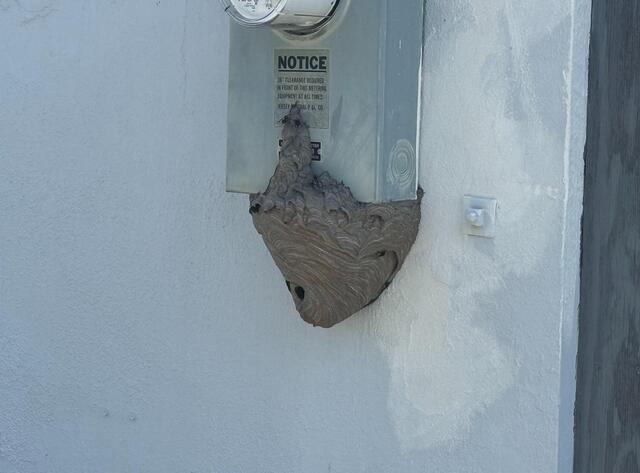
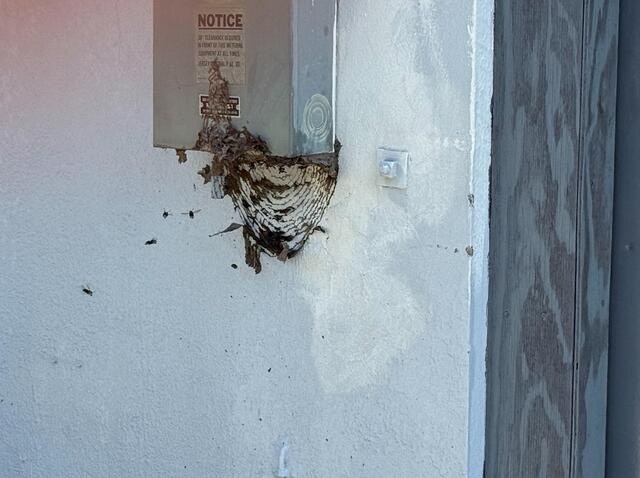
Recently, I was dispatched to a residence in South River, NJ. The homeowner was having a problem with yellow jackets. These wasps with their distinctive yellow-black coloration are one of the most territorial, aggressive stinging insects we come across. They seem almost anxious to sting at the slightest provocation.
Although yellow jackets often nest outdoors in rodent burrows and other cavities, sometimes they decide to build nests inside homes. Decks, eaves, soffits, gutters, and even holes in brick are all potential yellow jacket nesting sites. Here, the wasps found an opening of a roof dormer soffit. The homeowner realized he had a problem because he was hearing buzzing and light scratching/clicking sounds in his upstairs ceiling. These wasps, as many wasp species, will chew on wood because cellulose makes for great nesting material. They are powerful enough to chew through drywall. These were some of the sounds that the homeowner was hearing. By the way, don’t knock on the drywall. It may be so paper thin that you’ll make a hole in it!
Upon arrival, I immediately inspected the exterior and observed yellow jackets entering and exiting the dormer soffit. I also saw a paper hood protruding out of the soffit that was clearly part of their nest. Yellow jackets build paper nests that are completely surrounded by a paper envelope. This paper-like pulp is a mixture of chewed wood fibers and their saliva. Inside, I inspected the upstair ceiling and found that the moisture from the nest had soften the sheetrock.
It was time to treat the nest. Because of the aggressive nature of these wasps, i don’t take any chances. I put on my protective suit with a hat and veil to protect me against any insect stings. When yellow jacket nests are first treated, you are often “greeted” by a swarm of angry, aggressive wasps. A individual yellow jacket can sting multiple times, so f a nest is disturbed you can be facing dozens of painful stings. For obvious reasons, active yellow jacket nests, especially those built in challenging locations, are not DIY homeowner projects.
I climbed on the roof and used an extension pole sprayer so I could keep as safe a distance as possible from the nest, and injected a dust into the soffit opening. The dust will be shared with all of the members of the nest and it won’t take long for the queen and the rest of the colony to be eliminated.
Floor Drains Loaded with Fruit Flies in Metuchen, NJ
After noticing a large number of fruit flies in his sink room, this customer in Metuchen, NJ called Cowleys for help. During our inspection, we noticed that the fruit flies were hovering around one of the floor drains. As we got closer we noticed that there was some food debris sticking out. With the owners permission, we unscrewed the covers and discovered that the floor drains were loaded with food & liquid debris and fruit flies! This was were the fruit flies were harboring.
First, we applied a liquid application in the floor drains and scrubbed them out with our heavy-duty scrubbing brush. This product removes the bad bacteria from the drain, which is the breeding ground for the fruit flies. Next, we applied a bio-foam solution that removes the organic build-up, odors, and scum in the drains. As a precaution, we repeated this process to ever single floor drain in the area. Lastly, we applied a fly bait, which will exterminate the adult fruit flies.