Wildlife Removal Before & After Photos
Click on a photo to enlarge.
Raccoons Invade Homeowners Shed in Freehold, NJ


As this homeowner in Freehold, NJ was putting his gardening equipment away in his outdoor shed, he came across a raccoon exiting from the gable vent! He closed the door and immediately called Little Rascals for help.
When we arrived, we noticed that the raccoon had destroyed the gable vent in order to gain access to the shed. We temporarily enclosed the area off with hardware cloth and installed a one-way device over it. A one-way device will allow the raccoon to safely leave the area but prevent it from getting back in. We also placed several baited devices nearby.
A short while later, we successfully retrieved the raccoon and relocated it to a new, humane environment. In order to prevent any other raccoons, or any other nuisance wildlife from reinfesting the shed, we installed an XclusionPro® louvered vent guard over the gable vent. This sturdy material is made of expanded galvanneal steel and will exclude all nuisance wildlife.
Excluding Bats in Morganville, NJ


This homeowner in Morganville, NJ had an issue with bats roaming around his attic, so our Nuisance Wildlife Division was sent out and safely removed them from the home. Now that the bats are gone, we need to make sure they don't get back in!
After a thorough examination of the home, we determined that the bats were able to enter the home via the ridge vent & the attic fan. To fix this, we installed Ridge-Guard® and an attic fan cover. Ridge-Guard® secures and reinforces the ridge vent shingles so that bats, flying squirrels, and other nuisance wildlife are unable to enter. The attic fan covers are made out of heavy-duty 18 Gauge expanded Galvannealed steel mesh and prevents all nuisance wildlife from entering the home through the attic fan. Not only is the home properly secured from bats, but all nuisance wildlife too!
Excluding the Squirrels from the Gable Vent in Morganville, NJ


This homeowner in Morganville, NJ, had an infestation of squirrels in their attic. After a thorough inspection, we discovered that they were entering the home via the gable vent. Squirrels infesting a home via the gable vents is very common as over time, the gable vents get weathered and squirrels (and other nuisance wildlife) have no problem ripping away these vents to find shelter inside a home. After installing our retrieval devices, in a short amount of time, we successfully and safely retrieved all the squirrels and relocated them to a new, humane location.
Before we left, we removed the broken gable vent, disinfected the attic, and installed a louvered vent guard. This material is made out of heavy-duty Galvannealed steel (which means it won't rust) and is customized to accommodate vents of all shapes and sizes. Now that it is installed, squirrels and other nuisance wildlife will no longer be able to enter the attic through the gable vent.
Denying Squirrels Access to the Gable Vents in Marlboro, NJ
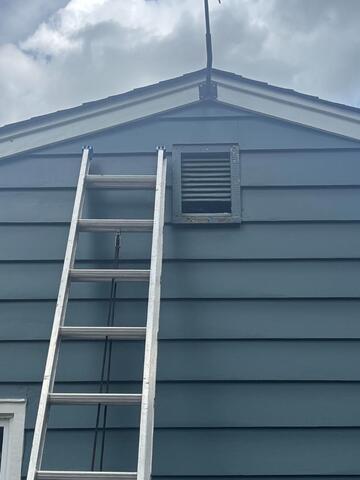
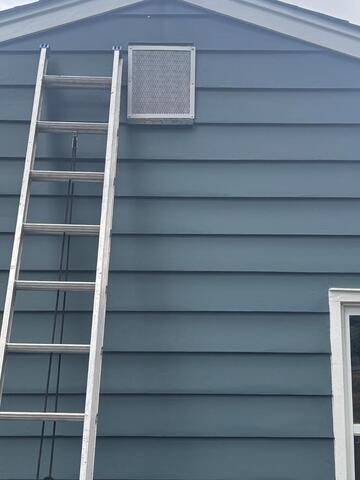
After finding a squirrel in his attic, this homeonwer in Marlboro, NJ called Little Rascals for help and we were sent out. When we arrived, we first inspected the exterior to find out exactly how the squirrel was getting into the home. Moments into our inspection, we found out! The gable vent was wide open, damaged, and exposed. Nuisance wildlife infesting a home via the gable vents is very common. Over time, the gable vents get weathered and raccoons, squirrels, birds, and bats have no problem ripping away these vents to find shelter inside a home - which is exactly what happened here!
To retrieve the squirrel, we installed a positive set over the gable vent and temporarily enclosed the area with hardware cloth. A positive set is comprised of a nose cone, which will guide the squirrel into a two-gaited, heavy-duty device. This is called a positive set, because we are positive that the squirrel will have no other way to exit except through our device! We also placed several baited devices nearby. A short while later, we successfully & safely retrieved the squirrel and relocated it to a new, humane environment.
To prevent any future nuisance wildlife intrusions, we installed Pest-Blok over the gable vent. Pest-Blok doesn't restrict the airflow to the attic, undergoes a silicone-protected polyester coating process that makes it last longer, and guards the home against all nuisance wildlife.
Raccoons Wreak Havoc in Attic in Carteret, NJ


These homeowners in Carteret, NJ found themselves with a raccoon infestation in their attic. Our wildlife technicians quickly trapped and relocated the trespassing animals. Unfortunately, as often happens, the attic insulation was contaminated and destroyed. Raccoons, with their razor-sharp claws, will shred through the insulation and use it as nesting material. Also, they deposit their wastes and urine all over it. Once this happens, the saturated insulation is not salvageable. There is no choice but to remove and replace it with new insulation.
A Cowleys installation crew arrived to make the attic as good as new. Our goal was to remove any traces that the attic was once a home to wildlife. After removing the contaminated insulation, we sanitized and deodorized the entire attic to remove any and all “evidence” that there once was a raccoon infestation, including the pungent smells left behind. After a wildlife infestation, it is critical to have the attic thoroughly cleaned — not only to remove dangerous pathogens but also to remove any remnants of an infestation, which can be an attractant for other raccoons and wildlife to follow. Wildlife cleaning and sanitation is not a DIY weekend project. This stuff is dangerous! When droppings are disturbed, airborne waste particles are released into the air that can be breathed in and cause serious, chronic respiratory infections. Animals droppings in an enclosed area are a serious bio-hazard. This waste should only be removed by someone who is trained in using proper protective equipment.
After the cleaning and sanitation, we installed our blown-in cellulose insulation. This insulation has excellent thermal properties and, because it is blown-in rather than cut to size like fiberglass batts, all areas of the attic, down to the smallest nooks and crannies, are insulated. This insulation will pay for itself over time with reduced heating and cooling bills.
The installation crew was especially proud of this project. We successfully transformed an attic that was destroyed by invading wildlife into a clean, beautiful, functional space that will improve the home’s energy efficiency.