Pests We Treat - NJ Homeowner's Guide to Fruit Flies
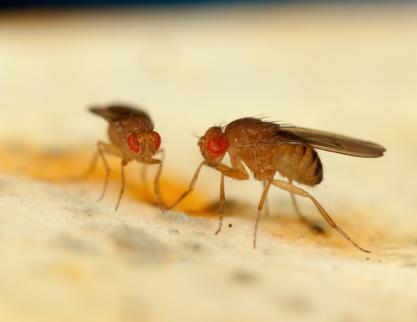
The common fruit fly, Drosophila melanogaster, is a species of fly in the family Drosophilidae. They are most often referred to as fruit flies but are also called vinegar flies. These flies are common throughout the United States, in fact, they are found on every continent except Antarctica.
Physical Characteristics:
Adult fruit flies are commonly found to be 1/8 of an inch long and 1/16 of an inch wide. They have an oval shaped body, which contains three segmented parts, and six legs are attached to its body. The fruit fly also has short antennae attached to its head. Their wings, which are attached to the middle segment of its thorax, extend past the end of the fly’s body. In the third section of the thorax the fruit fly has a second set of wings. These rudimentary wings are referred to as halters and are used to help the fly balance. The fruit fly’s mouth is developed to consume liquids.
The front part of the fruit fly’s body, including their abdomen, is a medium to light tan color while the rear section of their body is a dark color and sometimes looks black. An increased amount of pigmentation on the posterior of the fruit fly can help determine whether the fly is male or female. Typically, males have more pigmentation than females. In general, female fruit flies are slightly larger than their male counterparts. Another discrepancy between male and female fruit flies is male fruit flies have sex combs on their front legs. Although it has been theorized that these hair-like structures are used for mating, when the combs are removed there was not a significant impact on the male’s ability to mate.
Although they are small it is often possible to see the protruding red eyes that sit on the fly’s rounded head. Most fruit flies have red eyes, however, there are some fruit flies whose eyes are darker, almost black in color.
Reproduction:
As in all insect species, fruit flies lay eggs. Like most other flies, the fruit fly goes through a four stage life cycle. Fruit flies begin as eggs, they then go through the larval stage and the pupal stage before emerging as a reproductive adult. The fruit fly egg is very small. It is approximately 1/64 of an inch long. Adult fruit flies lay their eggs under the skin of fruit or on other materials that will be a source of nourishment for the fly at the larval and pupal stages. After an egg is fertilized it takes approximately twenty-four hours for the embryo to develop and hatch into a larva. The larva (maggots) that were placed on the fruit will immediately begin to eat which allows it to grow significantly in a short period of time. The larva will molt one day, two days, and four days after it hatches. After its last molting the larva will turn into an immobile pupa. Over the next four days, the pupa’s body will completely change and the adult winged form will emerge. The amount of time it takes for the fruit fly to go through these four stages can be significantly influenced by the air temperature. When the temperatures are closer to sixty-five degrees Fahrenheit it will likely take twice as long for the fly to develop compared to a fly that is going through the cycle at seventy-seven degrees Fahrenheit. Under the right conditions, a fruit fly can go from the egg stage to a sexually mature adult in one week.
Habitat:
Fruit flies can be traced back to the tropical regions of the Old World. Through commerce, especially the shipping of fruits, fruit flies are now found throughout the majority of the world. Although they can be found on every continent besides Antarctica, the fruit fly’s range is limited by elevation, high latitudes, deserts, cool weather, and availability of water.
The scientific name Drosophila means “lover of dew”; this name was most likely given to the fruit fly due to their need to have access to moisture in order to survive. Fruit flies are also more abundant in warmer climates. This is most likely due to the extreme effect temperature plays in the ability of fruit flies to reproduce.
In a home, fruit flies are most often found in a kitchen because the kitchen will provide them with both the food and moisture they need. Many times fruit flies will seek shelter in the colder months and return when the temperatures are high enough to allow for breeding.
Concern for Humans:
Unlike some other insects, the fruit fly has not developed a mouthpart that allows for biting. They do not feed on human blood and therefore cannot transfer disease into someone’s blood stream through their saliva, however, there should still be some concern with fruit flies. Fruit flies are often found on rotting organic material; they can transfer germs from these food to the foods we eat.
Fruit Fly Use in Science:
Homeowners, restaurant managers, and produce sellers may all find fruit flies to be a nuisance, but many scientists believe they are the most valuable organisms in biological research. Fruit flies have played a particularly important role in genetics and developmental biology. Fruit flies play such an important role because of their quick reproduction, their relatively low level of complexity and the fact that they share seventy-five percent of the genes that cause disease with humans. Today there are several thousand scientists working with fruit flies.
Ways to Reduce the Fruit Flies in the Home:
Although fruit flies are important to science they offer no benefit in a home. In order to reduce the fruit fly population in a home the fruit flies breeding ground must be removed. Fruit flies are known to lay their eggs in rotting fruit and other organic material that is soft and sweet. If there is a fruit fly infestation in a kitchen, all overripe or damaged fruit should be disposed of immediately in an outside receptacle. All remaining fruit should be placed in the refrigerator. All additional fruit that is brought into the room should be kept in the refrigerator until it can be determined that the infestation is gone.