Cowleys Pest Services Before & After Photos
Click on a photo to enlarge.
Removing the Bald-Faced Hornet Nest in the Tree in Adelphia, NJ
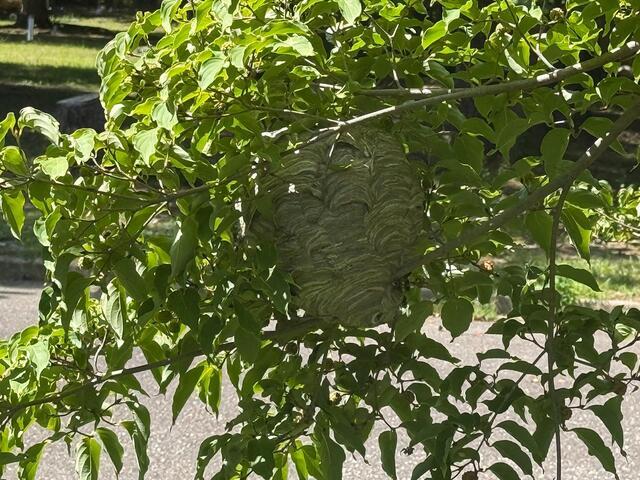
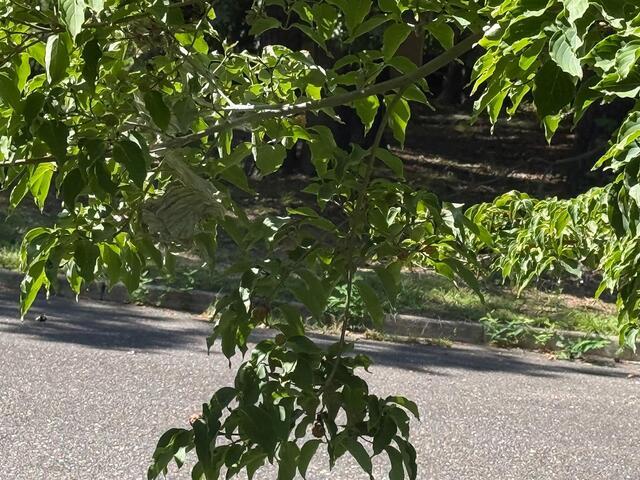
As this homeowner in Adelphia, NJ went outside to tend to his yard, he spotted a large hornet nest in one of his trees. Since he's highly allergic he immediately contacted Cowleys and we were sent out. When we arrived we equipped our protective bee suit and examined the nest. That's when we identified these stinging insects as bald-faced hornets!
Bald-faced hornets are social stinging insects that are a close relative to yellow jackets. The surface of their upper midsection almost looks triangular from the side, and they have white markings on their face. They are EXTREMELY aggressive and will not hesitate to sting anything that invades their space. Their stings carry venom that makes the stings hurt, itch, and swell for about 24 hours. Humans are at the same risk of allergic reactions from bald-faced hornet stings as with other insect stings.
We treated the nest with a knockdown aerosol and a knockdown dusting application. These two treatments will quickly neutralize these aggressive stinging insects. A short while after applying our treatments, we removed and dispose of both the nest and the branch it was attached to.
Mud Wasp Infestation in Cliffwood, NJ


I was sent to a home in Cliffwood, NJ when the homeowner contacted Cowleys after finding a wasp nest above a window in a seldom used room.
Upon arrival, I went to the room where there was a wasp nest. Based on the shape and construction of the nest, i immediately recognized it as a mud dauber nest. Mud daubers are solitary wasps that, unlike social wasps like yellow jackets and baldfaced hornets, do not live in colonies with a queen and hundreds of specialized workers. Instead, each female breeds and tends to her own. For the most part, solitary wasps like mud daubers are not territorial with regard to their nests. They are not aggressive, and they seldom sting people.
These wasps also known as dirt daubers or mud wasps, and for good reason. The female constructs small nests by carrying little mud balls to the nest site. She uses the nests to keep her eggs warm. The nests are built as cylindrical tubes that look like a pipe organ (the most common species in New Jersey is known as the organ pipe mud dauber).
I removed the active nest that already had several eggs and wasps in various stages in their life cycle. Homeowners can control mud dauber populations in their home by controlling spider populations since they live, for the most part, on a steady diet of spiders. By sealing cracks where spiders can live and regularly removing spider webs, you should not have a problem with mud daubers. However, if you do start seeing these strange little mud nests around your home, call a pest control technician to remove them. While these guys are not actively looking to sting, if you start trying to scrape away their nests as a weekend DIY project without the right equipment and products, you’re asking for trouble.
Gable Vent Broken Thanks to Squirrels in West Creek, NJ
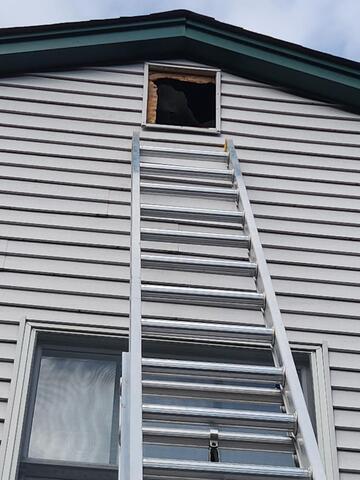
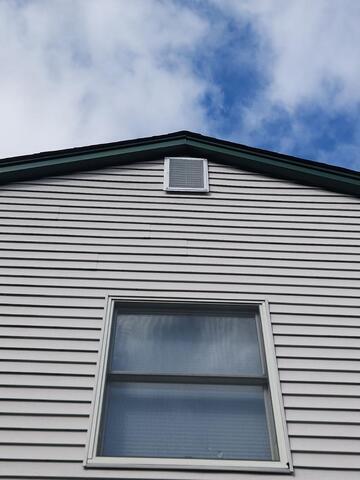
This customer in West Creek, NJ had a big problem. A squirrel had completely destroyed their gable vent and infested the attic. Once we had safely removed the squirrel and took it to a humane location, we disinfected the attic. We then installed a new gable vent and also installed a louvered vent guard over the new gable vent to strengthen it. This material is made out of heavy-duty Galvannealed steel (which means it won't rust) and is customized to accommodate vents of all shapes and sizes! Now the area is protected from squirrels, raccoons, bats, & birds!
Crawl space makeover could win an award - Crawl space repair & encapsulation in Forked River


A Forked River homeowner wanted to improve his crawl space with a better alternative than traditional vapor barriers. For better or worse, crawl spaces are a chronic problem for homeowners when it comes to water, moisture, and mold issues. Many homeowners in New Jersey, especially those from the Jersey Shore who live near large bodies of water, are often faced with crawl space issues. This Forked River homeowner, like many homeowners who live in towns near the Barnegat Bay, was no exception.
For this homeowner, we installed a full “CleanSpace” Encapsulation System. “Cleanspacing” transforms chronically wet, damp crawl spaces into clean, dry areas that keeps away water and moisture.
Removal of Hornets Nest in Millstone Township, NJ


Recently, I was sent to a home in Millstone Township, NJ for a periodic inspection and service visit that’s included in our residential home protection plans. These plans are valuable to homeowners because we often uncover pest problems that are overlooked by homeowners, especially outdoor infestations and infestations in their early stages.
During my inspection, I observed a hornet just starting to make a nest on an overhang of the front door. Hornets are highly territorial insects and a nest in any high pedestrian traffic area is a problem. If this nest was not removed, residents and guests of this home could easily be perceived as a threat to the nest and suffer the consequences. Hornets are a formidable threat since they often attack as a swarm. Their venom is especially painful because it contains high levels of acetylcholine, a chemical that stimulates our pain receptors. Also, a single hornet is able to sting multiple times because, unlike bees, its stinger remains intact and does not become lodged in the victim. Since hornets are large insects, they carry a good supply of venom, and release more venom per sting than any other stinging insect. Suffice it to say, I was glad that I was able to locate and treat this nest while it was still in its beginning stages of being formed. By removing this nest now, this household avoided a serious stinging insect threat.
Fortunately, since the nest was just starting to be formed it did not pose much of a threat to remove it. And that was just fine with me! First, I sprayed the nest with an aerosol foam to knock down any hornets in the nest. Once I saw that there was no more live activity, I safely removed the nest, bagged it, and carried it with me off the property. The homeowner was quite appreciative that I caught this problem early on before the hornets had a chance to form a mature nest.