Cowleys Pest Services Before & After Photos
Click on a photo to enlarge.
Good detective works finds mouse entry under deck in Helmetta


I arrived at a home in Helmet for their scheduled home protection plan (HPP) servicing. Our residential service plans, which cover over twenty common household pests, include preventive perimeter treatments and indoor treatments as needed. Homeowners have unlimited service calls for any covered pest infestation throughout the plan period.
Upon arrival, to my surprise, the homeowner has told me she has been having mice issues for six months, but did not contact us because she had been “getting used” to having mice! As a pest control technician, knowing the property damage and health hazards that mice can cause, I politely explained that a homeowner can never accept or allow an infestation to continue and worsen. Even though mice keep to themselves and avoid human interaction, these pests can cause a host of problems. I was especially surprised because this homeowner had a home protection plan and was fully covered. All she needed to do was pick up the phone and call us. A Cowleys pest control technician would have been immediately dispatched to happily resolve the problem.
I started my treatment to get rid of this mouse infestation. This homeowner lived in a wooded area of Wall Township, and had mouse problems in the past. I replaced over twenty RTU mouse bait stations inside her home. These stations lock automatically when closed and require a special key to open, making them tamper-resistant to pets and children.
However, something didn’t sit well with me. This homeowner was still having active mouse activity in her home despite the array of bait traps that were set. I was extra-thorough while inspecting for possible entry points in order to satisfy myself that there were no major openings. I crawled under her deck to check for possible exterior entry points that would match up where there was extensive mouse activity inside the home. My intuition and perseverance paid off. I successfully located a major rodent entry point. As shown in the attached picture, you’ll often see piles of droppings near entry points along with small hair follicles that have rubbed off. Here, the mice pulled out insulation, creating a tunnel for them to come and go as they please. I sealed up the hole with copper mesh to make sure that this entry point would be blocked for good.
The homeowner was pleased with my service. Before leaving I emphasized to her that she should never hesitate to take advantage of her home protection plan, and call us at the first sign of trouble. Pest infestations, whether rodent or insect, are unacceptable to live with. The sooner we come, the less entrenched the infestation, and the easier it is to resolve. Mice may appear to be small, harmless, and docile. But don’t be fooled by their appearance. Once they infest a home, these little creatures can cause significant property damage through their constant gnawing. Also, their toxic droppings can become airborne once they dry out, spreading disease. And mice invading kitchens can contaminate food. If you see mice or signs of a mouse infestation, it is a genuine emergency. For your family’s safety, contact a pest control service immediately.
Raccoons find way into Lakehurst attic


Usually, raccoons are messy creatures that leave behind plenty of evidence of their activities to indicate how they managed to break in to someone's home. Raccoons are large animals that can weigh up to twenty pounds, and usually, it doesn’t take much effort to find the hole used to gain access inside the home. However, this particular job in Lakehurst was one in which the point of access into the attic wasn't so obvious.
During my attic inspection, I saw raccoon droppings, which are fairly large like dog poo. If you see berries in the poo, you're pretty much guaranteed that it was deposited there by a raccoon. And, whatever you do, don’t touch it! Their waste may have raccoon roundworm that can be transmitted to people, causing a host of serious problems, including blindness. Also, insulation had been pushed down and moved. So, I knew that I was dealing with at least one raccoon, but where and how entry was made was not immediately clear. I searched the exterior perimeter of the house looking for the usual entry points. Often, weaken soffits and fascia boards are used by raccoons to gain entry. There was no indication of any breach. I was determined to determine how these little rascals where gaining access. I then checked a less usual entry point, the attic fan in the middle of the roof. Sure enough, something was amiss. The fan’s mesh liner that acts as a barrier to prevent things from getting in, was visible. Something strong had grabbed it and pulled it off.
I knew that I was “in the zone” and inspected more closely. I saw distinctive raccoon paw prints,and scratch marks on the metal flashing around the attic fan. Raccoon tracks are very distinctive from other nuisance wildlife. These animals have five long splayed toes with small sharp claws. Their tracks are asymmetrical and resemble small human hands. Their front tracks having a crescent-shaped palm pad and their hind tracks have a long heel pad. There were also raccoon droppings on the roof in the area of the fan.
I placed an exclusion (an attic fan cover with a raccoon exclusion built into it), over the attic fan. I also set two traps next to the exclusion. This setup will ensure that any raccoons have a one-way trip out of the attic. I expect to quickly and safely capture this wildlife. After, I will release them far away from human habitats where they can live out their lives in peace. Wildlife is wonderful, but wildlife infesting a home can not only cause significant property damage, but is also poses significant health risks. Raccoon urine and droppings carry many dangerous pathogens, and these sometimes vicious biting animals are the primary carriers of rabies.
Dehumidifier Service in Millstone Township, NJ


Recently, we were contacted by homeowners in Millstone Township, NJ who decided to have a dehumidifier installed in their basement as a permanent long-term solution to their chronic humidity problem. High moisture environments in crawl spaces and basements invites mold, insects, and even structural damage to the home.
The readings on our hygrometer, which measures the humidity (amount of water vapor) in the air, confirmed that this basement had an unacceptably high level of humidity. Homes require an acceptable range of humidity for our comfort and health, and air that is too dry or too wet can be the source of problems for a home’s occupants. Our homes are most comfortable at humidity levels between 30 - 50%. Almost always, the problem with basements and crawl spaces Is too much humidity. High humidity levels can cause condensation on windows, wet stains on walls and ceilings, musty odors, and over extended periods of time, wood rot and structural damage. humidity levels rise above 55%, a home is ripe for mold growth. Mold spores attach to wet or damp surfaces, consuming whatever organic material that it grows upon.
Based on the size (cubic volume) of the basement and its humidity level, we recommended a SaniDry XP commercial dehumidifier. We only install SaniDry commercial-grade dehumidifiers. These machines are specifically designed and manufactured for the challenging environments of basements and crawl spaces. Generic residential dehumidifiers simply aren’t up to the job. For example, the SaniDry XP is a powerful energy-efficient dehumidifier that outperforms standard household dehumidifiers by as much as 10 times while using the same amount of energy to run. The SaniDry XP can effectively cover indoor living spaces over 3000 square feet, making it well-suited for basements and crawl spaces over 40” high.
The most important difference between a residential dehumidifier and a SaniDry commercial dehumidifier is its ease of use and automatic operation. A residential dehumidifier requires human intervention to empty the pan of collected dehumidified water. If not timely emptied the pan will overflow and the machine usually huts off once the flow bucket is full. Our commercial dehumidifiers direct the extracted water pulled out of the air into either a sump pump or, if a sump pump isn’t present, a small condensation pump that pumps the water through a 1/2” condensate hose that runs to the outside of the basement. For this installation, we needed to drill a 1/2” hole through the foundation wall to run the hose outside. The installation went off without a hitch. Now, this basement will no longer have chronic humidity issues. The home will be more comfortable and the risk of dangerous mold growth has been removed.
Time to Replace Old Fiberglass Insulation with TruSoft Blown-in Cellulose Insulation in Millstone Township, NJ
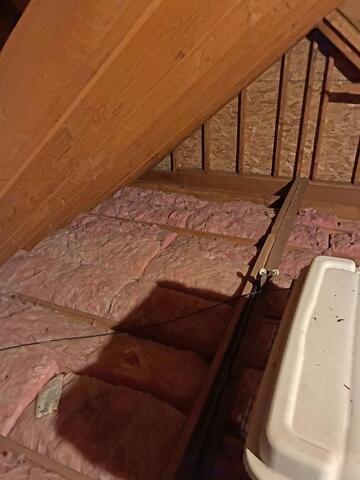
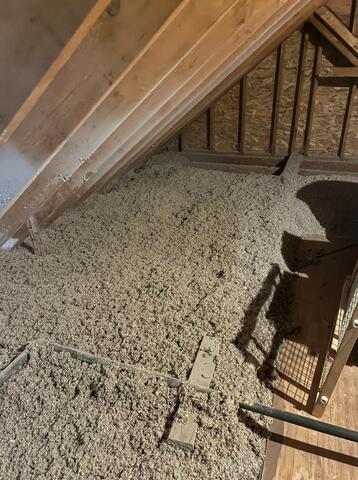
We're at a home in Millstone Township, NJ getting ready to add TruSoft blown-in insulation to the customer's attic. The owner hasn't replaced his insulation in over 30 years, so he decided it was time for an upgrade. First, we removed all of the fiberglass insulation out of the attic and disposed of it all.
Once we were done, we disinfected the entire attic and then added over 12 inches TruSoft blown-in cellulose insulation throughout the area. TruSoft fills the attic to its recommended insulation levels, has the highest Class-1 fire safety rating, is resistant to mold and pests, is eco-friendly, maximizes home comfort, and optimizes energy usage for year-round peace and savings for the homeowner!
Follow Up on the Flies in Restaurant in Millstone Township, NJ
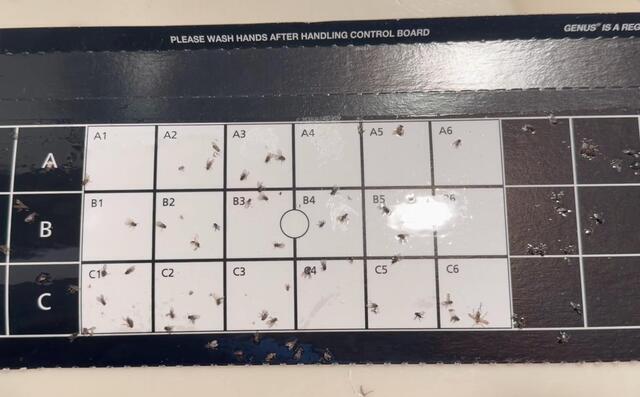
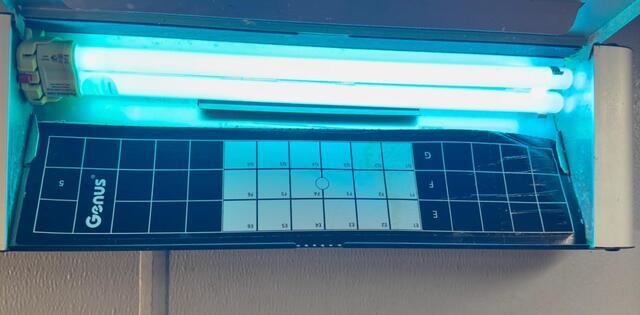
We're returning to this restaurant in Millstone Township, NJ to check up on the fly activity. Previously we installed several UV fly lights in several rooms of the business. These devices use an insect-attracting lamp to lure insects to an adhesive trapping glue board. They lure and capture virtually any flying insects such as house flies, bottle flies, mosquitoes, gnats, and moths. When we checked up on them, sure enough, we found activity on all of the glue boards!
We changed out the glue boards, cleaned out the fly light, and disposed of all the flies. Next, as a precaution, we applied a fly bait around the recycling and garbage cans inside and outside the building. We then scheduled another follow-up visit to monitor the infestation, replace the glue boards, and, if needed, apply any additional treatments.